analytic

Monday, 25 November 2013

What's that we want, Freedom!!


The 6th Delhi Queer Pride was hosted on 24th November and the streets of New Delhi was filled with the echo of a question, "Hume kya chahiye?" "Aazadi!!" - "What's that we (queers) want" "Freedom".

The freedom to be what we are, the freedom to love who we want without stigma and prejudice.
In spite of those prying eyes and intimidating stares, the LGBT members kept their head high and celebrated the pride at its best.


It was flabbergasting to see the number of attendants and supporters with some serious slogans in hands as well as some fun gay men in perky apparel.


The celebration was grand and cheerful. as gay as it could be. Drags and lipsticks danced cheerfully and the sassy dressed just perfect as Divas.

People in colourful costumes flaunting their sexuality marched towards Jantar Mantar. They danced to drum beats and shouted slogans like 'My mother thinks my girlfriend is a lesbian', 'fifty shades of gay' and 'Keep your laws off my body'.


Typically talking about India, it was a very relieving site to see the family supporting their gay boys and friends cheering their lesbian girl-friends. Though there are many of them who are to unleash the masks and even a lot many to come out of the denial and the community members and activists are really working for it. Gay guys are much more confident now than before and more cheerful.

Friday, 25 October 2013


Old Delhi and Jama Masjid

So, there are many things to do in Delhi; Delhi has many characteristics as a place, offers traditional aspects, delicious cuisines, nightlife and many places to see. Some of the places in Delhi look beautiful and remain charming ever.

Every few distance you travel in Delhi takes you to a different world where the scene and the lifestyle become very dissimilar from one another. As you see Delhi and gradually explore places, Old Delhi comes along at some point – locating at the heart of the city. Traveling to Old Delhi comes across with a lot of excitement, fun, and a
sense of alertness thinking of what you would see and do when you reach there. Old Delhi covers the areas of Chandni Chowk and Chawri Bazaar; you can reach there by the metro service or any other transportation. Your walks on the streets of Old Delhi will widen your eyes where you will see a kind of unfamiliar scene, as you will start thinking about the place deeper.  Rickshaw pullers, street foods, restaurants, hawkers and people come in numbers here – you will be amazed and thrilled at this time. Your day in Old Delhi will come with a price; looking around the massive and maddening bustle, walking on your feet, your exploration of Old Delhi will be without question laborious. But there is something about Old Delhi


that no one would deny – the essence, of olden times, nostalgia, and the beauty hidden under a surface that you can see gauzily. Trying to tell you stories, and unveil itself from the thin scarf, Old Delhi will show you some parts of its face, and amidst the scene inside the place you will hear a narration and feel a distraction. There are houses on the side of the streets that dates back to ages, some of the glasses of the doors and windows on the upper floor shining with sections of translucent green, blue and red. It does not come difficult to imagine Mughals residing there once.


At the beginning of the Chawri Bazaar road is the Jama Masjid, the largest mosque in India. The area around Jama Masjid is covered with shops, people, noise and rush. Tall it stands you will see the minarets of the mosque from a distance. You will definitely want to see the inner area of the mosque, but there could also be a chance you would think of passing it – don’t do that.


The compound of the mosque spreads wide and big, and there stands the mosque – beautiful, massive and charming. Remove your shoes at the entrance of the mosque; this is the regulation given before you enter the mosque. Once you enter the compound of the mosque – there is it, right in front of your eyes. You will find people visiting the mosque for prayer or just hanging around – local people: family and friends, and travelers. The minarets of the mosque stands tall and just looking up in the sky and finding it there is a beautiful sight. Right across the opposite of the mosque in the compound leads to another passage, and from this spot you could see a panoramic view of the Red Fort. The courtyard of the mosque can hold up to twenty-five thousand worshippers where on every Friday noon, the masjid holds mass congregation prayers of muslims. Jama Masjid began its construction in 1650 and was completed in 1656, foundation taken by Shah Jahan.


If you are in Old Delhi, don’t leave the place without feeling delicious in your mouth. Known for flavorsome Mughlai cuisine, food is one of the souls of Old Delhi – numbers of food corners near Jama Masjid or anywhere 
around as restaurants or street shops. The food here is pretty much tempting with the aroma, texture and the delicacy when brought before you. Karim’s restaurant is located just by Jama Masjid and it is a famous restaurant particularly known for its delicate food and taste. The restaurant offers a menu with a variety of items, all delivering flavor and taste. History lies as a backdrop of the restaurant – it dates back to 1913.


Old Delhi is all about seeing, moving and experience; several other spots also lie in and around its areas like Red Fort, Mirza Ghalib’s haveli, Razia Sultan’s tomb, and Begum Samru’s palace which now stands as an old and weary building. Old Delhi is nothing but one of the rare places that you would find; with history and fascination it is an occasion - you will go back home with pictures and images in your head.

Monday, 7 October 2013


Beauty, Green, Move.


The experience of visiting a waterfall and enjoying the beauty is something more than what we really expect. First, it’s the beauty that captures us, not just ordinarily but that completely steals our attention from anything else. When you go deeper and see a fall, this is when you get the real catch – enjoyment and thrill. The water runs down with full strength and exhilaration, and doesn't stop to fall. Nuwara Eliya offers a number of waterfalls, all full of scenic beauty and wonder. The mountains near to this area are filled with many picturesque waterfalls including Devon falls, Dunhinda Falls, Diyaluma Falls, Baker's Falls, St. Claire's Falls, Ravana Ella, Bambarakanda Ella, Aberdeen Falls, Laxapana Falls, The Lovers Leap, and Bridal Falls. Devon falls and St. Claire’s falls are the most notably ones among all; the remaining falls are nevertheless still stunning.
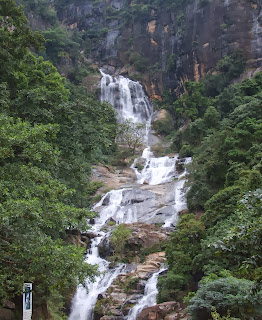

Since most of the waterfalls are close to Nuwara Eliya, visiting the falls does not come difficult. Devon falls is the highest fall in Sri Lanka, and located 6 kilometres west of Talawakele, Nuwara Eliya District. The fall looks beautiful and journey to the fall is very exciting; you will see a long stream of falling water from a distance on your journey, with a picturesque landscape of hills and greenery. Another popular waterfall, St. Claire’s might just become one of the most beautiful and charming waterfalls you have ever seen – tea plantation, trees and hills all around, and the fall in serenity and seclusion. Overall, this fall is simply magnificent, different and is just bliss to see.
Sri Lanka is abundant of nature; you can seek for a variety of interests you want – landscapes, wildlife, beaches, or adventure activities. Horton Plains and World’s End are commonly located near to Nuwara Eliya and are easily accessible. Horton Plains is a national park, and World’s End is a cliff. The park offers a rich variety of floras and faunas, with nearly 750 species of plants and 24 species of mammals, 87 species of birds, nine species of reptiles and eight species of amphibians. But the main attraction here comes to the World’s End, and as from the name, the end of the cliff provides you a scenic picture of emptiness far and wide. 

Another beautiful attraction in Nuwara Eliya is the Seetha Amman Temple, which is a Hindu temple holding interesting stories of history. In the famous epic of Ramayana, Sita was seized away from her husband by the king of Lanka. The temple is believed to be the place where Sita was held captive by the king Ravana. The temple has beautiful sculptures and statues of Indian Gods and Goddesses, and design very appealing.

Other attractions of Nuwara Eliya include the Pedro Tea Factory, which offers a scenic beauty of tea plantation on hills, Haggala Botanical Gardens and Victoria Park.

What could be more fascinating and contenting than to see all the beautiful creations of nature – visiting falls, wandering through tea plantations, and just simply having a cozy time.

Nuwara Eliya is a gift and a place to be seen; it will soothe the heart of anyone, will distract you from anything.

Thursday, 26 September 2013

Behind the curtain.

Some of the most beautiful sights of nature lie in hills and mountains: tall trees, snow clad mountains, rich culture and pleasant weather are some features that undeniably gives Tawang a beautiful and characteristic feature. A beautiful town existing in serenity in the north-eastern state of Arunachal Pradesh, traveling to Tawang and experiencing time there is nothing less than absolute happiness and enjoyment. The beautiful town has houses settling on the hills with great views all around, and the weather remains relaxing and pleasant all year round. Tawang is most beautiful during the snowfall; the town gets covered in white giving it picturesque cold scenery. The place is also filled with amazing lakes, variety of orchids, waterfall and hot springs. Such are the features that Tawang offers, which capture the interest of many people.


On the way to Tawang, you will cross Sela Pass; this is a spot where you will see a beautiful picture of nature – hills, lakes, and the beautiful sky completing it. In cold season, the lakes turn into ice where you could actually walk on. You will find complete remoteness in the area; the only thing that will give you company are nature, dogs and tea-stalls. Stop at one of the tea-shops, have a cup of tea and some snacks and take a beautiful break. The remaining journey all the way till Tawang are driving uphill, seeing lakes and mountains on the way and eventually reaching the charming town.


The town of Tawang is occupied by a group of people called ‘Monpas’, who are all Buddhists by religion. Culturally, Tawang has elegant and lovely aspects – festivals, art and craft and dances. Monpas have a great skill in craftsmanship which can be quite apparently seen in the beautifully designed traditional and artistic crafts available in the local market. Wooden mask, Dolom (wooden bowl), Zarkhu (wooden ladle), TokTse and Tun (wooden mortar and pestle) and other kinds of hand-made things are found in the markets of Tawang, and they are all beautiful items.

Historically, there had been hue and cry over the ownership of Tawang between British India and Tibet. In the beginning, Tawang was a part of Tibet but the 1914 Simla Accord defined the McMahon Line as the new boundary between the two countries which led Tibet surrender many areas of its territory including Tawang. Tawang also fell briefly under Chinese control during the Sino-Indian war of 1962, but ultimately Tawang came under the administration of India, locating it in the state of Arunachal Pradesh.

The most important characteristic feature of Tawang is the monastery, the biggest monastery in India and which is significantly popular among many people. With a backdrop of nature, the location of the monastery is beautiful and is both historically and naturally admired. Meaning ‘Chosen Horse’, Tawang monastery was founded in the 17th century according to the wishes of the 5th Dalai Lama. The monastery remains as an important place of worship for the people living there, and religious people from other parts of the country and the world. Visually, the monastery looks gorgeous with the yellow roofs on it and on the smaller houses around.


Tawang overall is nothing but a true divine experience. From the moment you start your journey till the end of it, you will see beauty, feel the calmness and experience a place that is so majestic – rare sights you will come across in life.


Visit http://www.irregulartours.com/north_east_india_expedition_tour.html#.UkQL9NJHIqM   for holidays to Tawang.

Thursday, 19 September 2013

Another world.


Orchha is one of the places in India loved by many people. It is a town in Tikamgarh district of Madhya Pradesh.


When you visit the place, the first thing that comes to you is the feeling - a sense of nostalgia, going back in time and some kind of sweet connection. As you look around, you will come across a huge palace fort consisting of several connected buildings. These buildings look like stories trying to tell them to you; the shapes of the temples - conical top section, the detailing on their surfaces, they are beautiful treat to the eyes. You will see the water of Betwa River surrounding the fort and spreading far, with stones around.


The Raja Mahal, Jahangir Mahal, Ram Raja Temple and the Uth Khana(Camel Shelter) are the places of interest in Orchha. You can also climb on the roof of the Uth Khana and get a fastastic view of Orchha town. The ruins behind the fort complex is an even greater watch. Nothing much other than thoughts about the things around you will be in your mind.

In brief, Orchha was founded in the 15th century AD, by Rudra Pratap Singh, who became the first King of Orchha, and also built the Fort of Orchha. The Chaturbuj Temple was built, during the time of Akbar, by the Queen of Orchha Ganeshi Bai, while Raj Mandir was built by Madhukar Shah during his reign, 1554 to 1591.


There's no thing like gay scene in Orchha, but it's the beauty and its charm that captures the heart of many people, and becomes an anticipation for gay men.


A visit to Orchha is worthwhile, it will fascinate and impress you. All that you will be left with is a feeling of going back to history, excitement and a number of pictures in your head.


Wednesday, 18 September 2013

Discrimination within the discriminated!


Coming from a small town, I always wondered if there's any gay scene in India, and after moving to New Delhi I realized that there's a loud vibrant gay scene in the bigger cities in India. I observed that a big number of crowd has started to stop fighting the fact about their sexuality and are accepting it in a positive way. Unfortunately, I observed that with this open crowd in cities like New Delhi, it has seeped in the some hideous norms and customs.
I am writing this article after having a long, serious conversation with a Spanish friend who has been living in New Delhi since a couple of years. Our conversation was lead in a direction making me think deeply about the fact that how rudely a strata of Indian gay community is discriminated by the gay community itself.
The conversation begun with the gay party scene in Delhi, I got to know that there are parties every weekend and generally on Tuesdays too, the parties are very happening and good. The conversation then headed towards the serious subject of how the transgenders and cross-dressers are discriminated and discarded by the gay community itself.
It was upsetting to know that they are not allowed in most of the parties in the city and are humiliated badly. The newsletter on the social networking sites have clearly written "Drags and transgenders are not allowed". 
This is because of the pressure that the gay community put on the organizers. There might be reasons behind this, but any kind of reason will not justify a conclusion like this. This striking fact tells us how unfair it is that when we come out on streets for the pride, we all talk about equality and freedom of choice but in real, things are contrary. The India gay community itself seems too homophobic.
Gay community in India clearly is divided into closeted and out-of-closet but there's another division, tabooed deeper - the discarded and the accepted gays.
Hope with time and more open minded people, the community which is already discriminated, by the straights and so called 'straight acting', will stop discriminating amongst themselves.


Friday, 13 September 2013

Go Goa, Go Loud, Go 'Out'


The land of Beaches, white sand, and of course plenty of gorgeous men! a refuge for men seeking escape from the daily haphazard of life and seeking charming wet men. The smallest Indian state, highly liberal in every sense is a fantastic gay holiday destination for winters. One of the few of the places in India that has bars, where gay crowd is visible - where it's just ok to be gay!


Lush green outskirts and clean white sand beaches, vibrant young crowd and completely insane parties can bring out the wild side of even a cub in the closet. Perfect sea food, amazing friendly ambiance where no gay guy shall get any negative attention.
The Baga Beach , Calangute Beach,  Hysons, Shivers are few of the most popular and happening beaches where gay men can meet other men for companionship. Men from all over the world holidays here, the more the merrier (Specially when we talk about variety!) .
Other than the wild side, Goa also has a very calm intact natural landscapes to allure nature lovers. On the outskirts of downtown.  For those who like trekking or are interested in nature are not kept upset,  after all it's not just men that we want to see all the time!


With Pink Vibgyor, get the most of the gay friendly experience in Goa!
If you are a group travelling, try out services of Irregular Tours .